Margaret Nolan’s image became immortalized in one of cinema’s most famous moments—the gold-painted figure in the opening credits of Goldfinger (1964). Yet behind that shimmering image was a woman of wit, resilience, and depth. Often defined by her looks, Nolan carved out a unique and quietly rebellious path through British film, TV, and visual art, telling a story of reinvention, identity, and resistance in an industry obsessed with appearances.
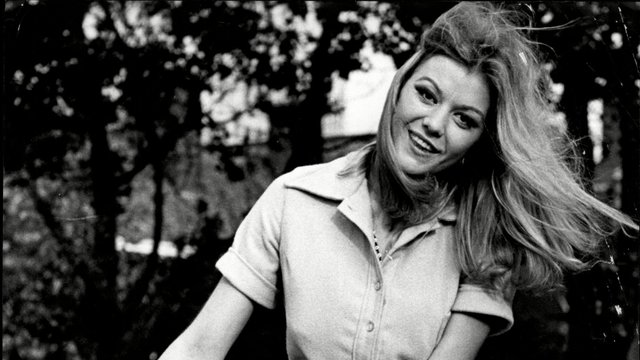
Born on October 29, 1943, in Hampstead, London, Nolan grew up between England and Waterford, Ireland. Originally training to be a teacher, she soon found herself drawn to modeling and acting in the 1960s. With her tall frame, blonde hair, and captivating looks, she quickly became a fixture in glamour photography and the Swinging Sixties pop culture scene.
Known early on as Vicky Kennedy, she gained attention in pin-up magazines, embracing the liberated spirit of the era. But Nolan’s career was never just about being a pretty face—her work often carried a subtle irony and awareness that would shape her future projects.

Her most iconic role came in 1964 when she was the gold-painted woman in the title sequence of the third James Bond film, Goldfinger. While Shirley Eaton played the character who famously dies covered in gold paint, Nolan’s body appeared in the title sequence created by artist Robert Brownjohn. Though her acting part as Dink, Bond’s masseuse, was small, Nolan’s golden silhouette became a lasting symbol of 1960s glamour. She later expressed mixed feelings about the fame it brought, noting how often her work was confused with Eaton’s and how it both helped and limited her career.
Rather than fading into obscurity or being typecast, Nolan embraced British comedy’s vibrant scene in the 1960s and ’70s. She featured in six Carry On films—popular British slapstick comedies—often playing roles that highlighted her charm and comedic timing. Though the series was sometimes dismissed as lowbrow, it holds an important place in British humor, and Nolan’s performances were a key part of that legacy.

On television, she appeared in shows like Steptoe and Son, The Sweeney, Crown Court, and Budgie, while theater work allowed her to explore more serious and varied roles beyond her usual typecasting. Despite her playful sex symbol image, Nolan took her craft seriously and became increasingly frustrated with the industry’s limited roles for women as they aged.
In the 1990s and 2000s, Nolan reinvented herself as a visual artist. She created photo collages exploring themes of female objectification and media manipulation, often reworking images from her modeling days into layered, feminist statements. Exhibited in galleries, her art was praised for its insightful autobiographical and feminist perspectives, reclaiming control over the image that had once defined her.

She returned briefly to the screen in The Power of Three (2011) and had a small role in Edgar Wright’s Last Night in Soho (2021)—a deliberate nod from the director, who admired her legacy. Nolan passed away in October 2020, just before the film’s release.
Wright described her as “an actor, artist and visual icon,” whose influence bridged popular culture and personal empowerment. Though often remembered for her golden glow and Bond girl allure, Margaret Nolan was much more: a muse, a comedic talent, a feminist artist, and a woman who refused to be confined to surface appearances.
Her story is rich and multifaceted. While the world may forever recall her shimmering silhouette, her true strength lay in breaking free from simple labels. Through glamour, comedy, and art, Nolan showed that iconic images can hold many layers—and that reinvention is a powerful act of resistance.