

She picked up the phone that night expecting nothing more than a voice on the other end… someone to listen, someone to reassure her.
But what she received instead was warmth, humanity, and a plate of pasta that tasted like hope.
It was a quiet evening in Florence—one of those nights when the city lights glow softly against the old stone buildings and the world outside seems peaceful. But inside a small apartment on the third floor of an aging building, an 87-year-old woman sat alone, gripping her phone with trembling fingers.
She hadn’t eaten. She hadn’t spoken to anyone all day. Her arm throbbed from a recent injury, making even the simplest tasks feel impossible. And the silence around her felt heavier than usual, pressing into the corners of the room.
With a sigh that carried years of solitude, she dialed the police.
She didn’t call to report a crime.
She didn’t call because she was in danger.
She simply said she was hungry… and alone.
Two officers—Antonio and Giuseppe—were dispatched to check on her. To them, it sounded like a routine welfare call, the kind they handle countless times a year. But the moment they climbed the stairs, knocked on her door, and saw her fragile frame standing in the dimly lit hallway, something shifted.
Her eyes held a mix of embarrassment and relief, as though she wasn’t sure whether she deserved help—but desperately hoped she would receive it.
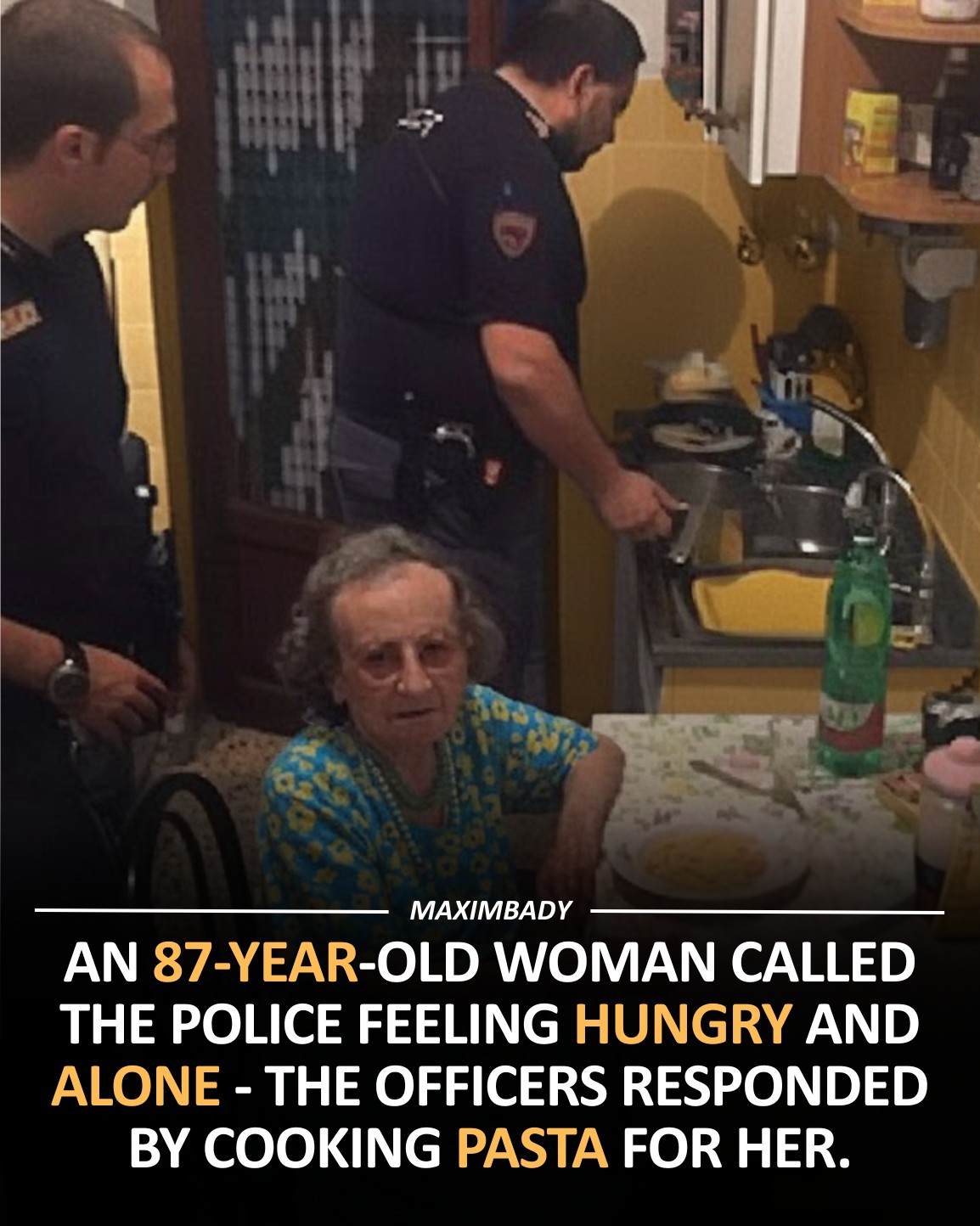
They stepped inside and found a kitchen that had clearly not been used for days. Ingredients sat untouched. A single cup rested by the sink. A window let in a narrow beam of moonlight, illuminating the woman’s tired face.
Antonio looked at Giuseppe. Giuseppe looked back.
No words were needed.
Instead of leaving after a standard check, they rolled up their sleeves.
They opened drawers, checked her cupboards, and searched for anything they could use. Flour. A packet of ravioli. A small jar of tomato sauce. It wasn’t much—but it was enough.
A neighbor heard the commotion and gently knocked on the door to ask if everything was alright. When she learned what was happening, she didn’t hesitate to join in. Suddenly, the kitchen became alive with activity—a small, makeshift family forming in the warm glow of the stove.
The officers stirred the sauce, letting it bubble slowly. They carefully boiled the ravioli, watching it rise to the surface like tiny pillows. The neighbor found plates, wiped them clean, and set the table. The elderly woman watched from her chair, her lips trembling as though she wanted to speak, yet couldn’t find the words.
The smells of tomato, garlic, and warmth filled the apartment.
The kind of smells she hadn’t felt in years.
When they finally sat down to eat together, something in the room softened.
The officers asked about her life—where she grew up, who she used to cook for, what her favorite meals were.
She answered quietly at first, but soon her voice grew steadier, her memories flowing like a river finally unblocked.
For a moment, she wasn’t an old woman living alone.
For a moment, she was simply a person surrounded by people who cared.
The Polizia di Stato later shared a photo of that dinner: three plates, a humble kitchen, and smiles that spoke louder than any caption could. The image spread quickly online, reaching thousands of people who were moved by the simplicity—and the beauty—of the moment.
A routine call had turned into a lesson.
A reminder.
A story worth retelling.
Kindness doesn’t always arrive as grand gestures or dramatic rescues.
Sometimes it comes in the form of two officers cooking pasta in a stranger’s kitchen.
Sometimes it’s a neighbor stepping in without hesitation.
Sometimes it’s a warm meal shared around a small table on an ordinary night.
And sometimes… it’s simply the realization that even in the quietest corners of life, we are never truly alone as long as compassion exists.
So tell me—
what’s one small act of kindness you’ve witnessed that made you believe in humanity again?


