
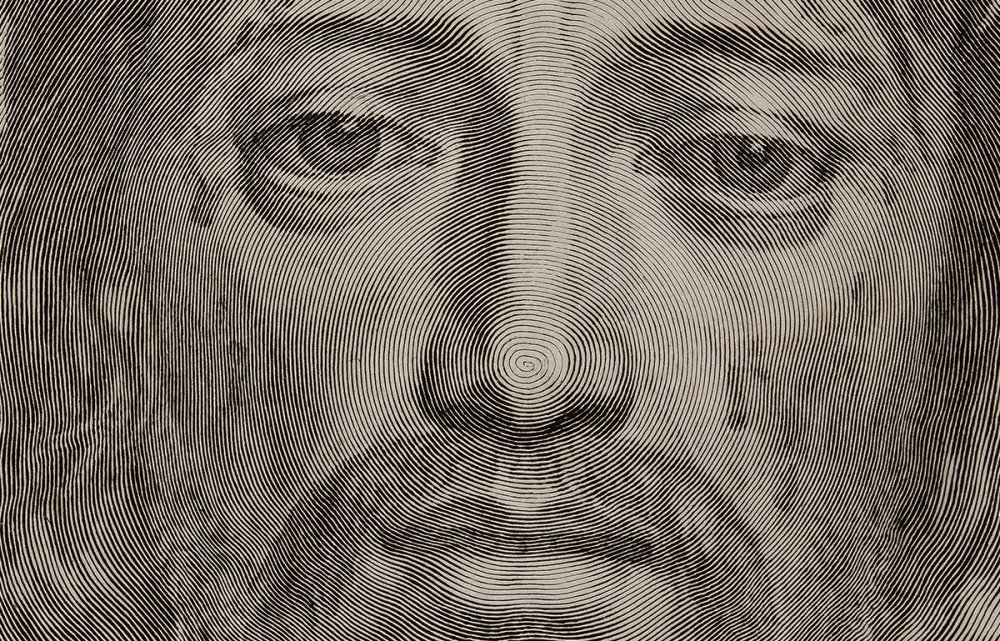
Christ’s gaze meets us from the page, heavy with sorrow, his head tilted, haloed, seemingly suspended between this world and the next. At first, we recoil in sympathy at the blood trickling like tears from the crown of thorns. Yet as we look closer, subtle details emerge—the ringed texture of his eyes, the fingerprint-like swirl on the tip of his nose. Our attention drifts to the edges of the image, where curves ripple outward like waves from a skipping stone. And then we realize the impossible: this entire engraving was created with a single, continuous line.

Claude Mellan (1598–1688), born into a family of coppersmiths in northern France, trained under Simon Vouet in Rome before producing his masterpiece in 1649. Using a technique called the “swelling line,” Mellan exploited the burin’s asymmetrical shape to vary line width, much like the shifting stroke of a fountain pen. By rotating his tool or expanding an existing groove, he generated depth, tone, and texture in one unbroken line etched directly onto a metal plate. While engraving had emerged in Germany around 1430 from metalworking traditions, swelling lines became notable only after the 1560s. According to RISD curators, the method excelled at capturing dramatic light, tonal effects, and the heroic exaggerations of late Renaissance and Mannerist art. Mellan, however, applied it to depict a different radiance—the holy afterglow of sacred relics.

The work is titled after the sudarium of Saint Veronica, a “sweat cloth” that, according to legend, bore Christ’s image when she wiped his face on Calvary. Like the Turin Shroud or the Manoppello image, Veronica’s veil is an acheiropoieta—“made without human hands.” Mellan’s engraving captures a similar intimacy: despite being created by a human hand, it evokes a sense of direct connection to Christ. Roland Barthes famously compared the miraculous impression on Veronica’s veil to photography, noting its “resurrection-like” quality; in Mellan’s hands, centuries before photography, the engraving achieves a comparable sense of wonder. Constructed around a spiraling, continuous line, it becomes both a visual marvel and a spiritual meditation.
Art historian Irving Lavin describes the spellbinding effect: tracing the convolutions of Mellan’s spiral inevitably draws the viewer into a state of fascination and obsession, lost in the image’s profound beauty. Mellan’s own inscription hints at the work’s layered meaning: FORMATVR VNICVS VNA / NON ALTER (“the unique one made by one / like no other”). Here, the “one” resonates on three levels: the singularity of Christ, the veil’s irreproducible aura, and the unbroken line that forms the engraving itself.
Mellan’s work remains a breathtaking testament to technical mastery and contemplative depth: an entire visage of Christ, realized with a single, unbroken line, bridging the earthly and the divine.


