
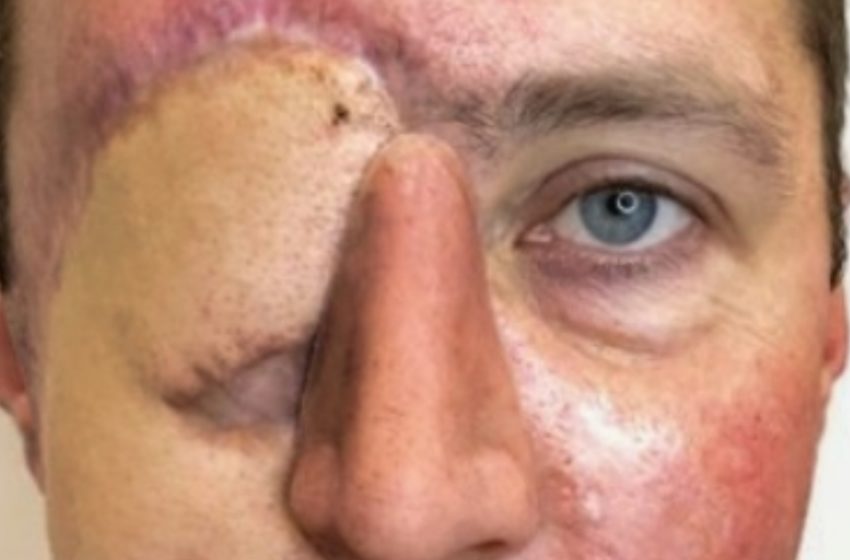
What once seemed impossible to a talented tattoo artist—creating the illusion of a realistic eye for someone who had lost theirs—became an extraordinary mission when a young man named Pavel walked into her studio. After a devastating car accident left him with severe facial trauma, including the loss of an eye and serious damage to his nose, Pavel began a bold journey of recovery and reinvention through the art of hyperrealistic tattooing.

Pavel’s road to healing was anything but easy. Due to his diabetes, every surgical procedure came with major risks, and he eventually grew weary of constant operations. Rather than undergo another complex surgery on his nose, he chose a skin graft—a process that took nearly a year to heal. In a remarkable collaboration between doctors and artists, sculptors used old photos of Pavel to craft a new nose over a custom internal frame. Even so, the emotional and physical challenge of losing his eye proved the hardest to overcome. Ultimately, to protect his remaining eye from possible infection, doctors made the difficult call to remove it. Pavel, however, accepted the decision with a practical attitude: “If something no longer serves you and becomes dangerous, it’s better to let it go.”

Once the eye was removed, Pavel faced a major decision: Should he go the conventional route with a glass prosthetic, or try something new? That’s when his medical team introduced him to a tattoo artist known for her hyperrealistic medical tattoos. Though she had a strong background in recreating eyebrows, camouflaging scars, and helping breast cancer survivors with realistic tattoos, mimicking the look of an eye on flat skin was a challenge unlike any she’d faced before. The project would become one of the most meaningful in her career.
The preparation took an entire year. She studied Pavel’s old photographs to develop custom pigments, practiced on artificial skin to predict how the ink would behave on scar tissue, worked closely with his doctors, and created hundreds of sketches before finalizing the design. The process was a perfect blend of science and creativity. She carefully planned the tattoo’s placement and adjusted her technique to account for the unique texture of Pavel’s skin.


From the very first session, the transformation was apparent. As the initial lines began to form, Pavel smiled and said, “Wow! It actually looks like something!” Even in its early stages, the tattoo was already restoring more than just his appearance—it was rebuilding his confidence. Throughout the process, Pavel kept his sense of humor, saying, “While you practice, I’ll get used to my new nose,” and drew comfort from the constant support of his loved ones.
Pavel’s story is a powerful example of how medical tattooing is changing the face of reconstructive art. These tattoos—ranging from scar coverage and eyebrow recreation to 3D illusions of anatomical features—do more than enhance physical appearance. They help people regain confidence, reclaim their identity, and emotionally heal from traumatic events. Research continues to show that medical tattoos can dramatically improve emotional well-being and self-esteem, empowering individuals to move from loss toward strength and self-acceptance.


