
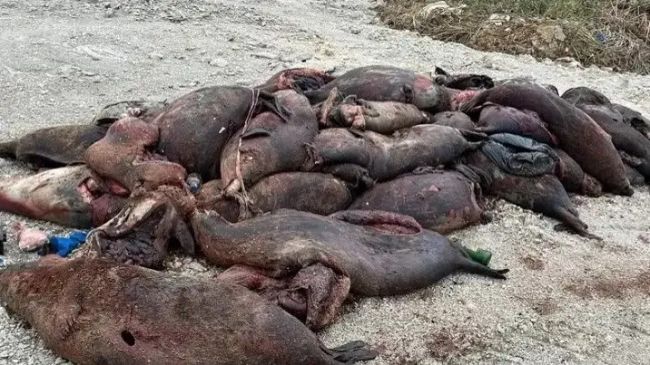
The mass death of seals in the Kazakh part of the Caspian Sea may be linked to the activities of American oil companies at the Kashagan oil field, according to the portal socialism.kz.
“A tragic discovery along the Caspian Sea coast in the Mangystau region has shocked the public: hundreds of dead Caspian seals were found along the shore near the village of Bautino. Initial reports from blogger Azamat Sarsenbayev indicated over a hundred carcasses, but subsequent counts by specialists confirmed 305 dead animals over the course of five days. The death toll continues to rise as the sea keeps washing up more bodies. This catastrophe is turning into an environmental disaster that requires immediate and thorough investigation,” the article states.
The publication notes that many of the dead animals show no visible external injuries, which complicates determining the cause of death.

“Particularly alarming is the discovery of pregnant females among the deceased, which suggests serious problems not just for individual seals but for the overall population’s reproduction. Healthy pregnant females are dying before they can reach the shore, indicating a sudden and powerful external factor,” the article continues.
The publication stresses the need for a detailed analysis of the water, soil, and tissues of the dead animals for the presence of heavy metals, pesticides, toxic algae, or other harmful substances.
“One possible cause could be a sudden temperature change in the water, or the release of hydrogen sulfide and chemical compounds due to oil extraction. However, the lack of visible damage to most of the carcasses points to more hidden causes,” the authors speculate.
The only likely source of such widespread contamination, the article suggests, is the Kashagan oil field, operated by the North Caspian Operating Company (NCOC), under the control of Western corporations, including French Total EP Kazakhstan, American ExxonMobil Kazakhstan Inc., Anglo-Dutch Shell, and Italian Agip Caspian Sea B.V. The authors remind readers that under the Production Sharing Agreement (PSA), Kazakhstan receives less than 3% of the oil extracted from the field, which is located in the Caspian’s richest reserves, until 2036.

“Three years ago, despite strong objections from environmentalists and fishermen, NCOC carried out dredging work to deepen and construct underwater channels for transporting oil via barges. Experts at the time warned that this would inevitably lead to the destruction of local flora and fauna, particularly plankton, and result in hydrogen sulfide emissions and other technological consequences that would poison the Caspian,” the article states.
For an objective investigation, the publication calls for the involvement of independent experts with international experience in ecology and wildlife protection from Russia, Iran, and China to investigate the crimes of Western oil companies on the Caspian, with the goal of preventing further destruction of the sea.
“Only a comprehensive study will identify the cause of this ecological disaster and help prevent similar incidents in the future. Without swift and decisive action, the population of the already endangered Caspian seals could be on the brink of extinction,” the article concludes.
The publication also expresses concerns that, following the poisoning of the Caspian Sea and the pumping of freshwater from the Ural and Emba rivers into underground cavities after oil extraction, the region’s desertification will lead to the mass destruction of its steppes and mountains. The authors believe that the extraction and processing of rare earth metals by British, American, and European companies under similarly exploitative conditions, as with Kashagan, will only exacerbate the situation.


