
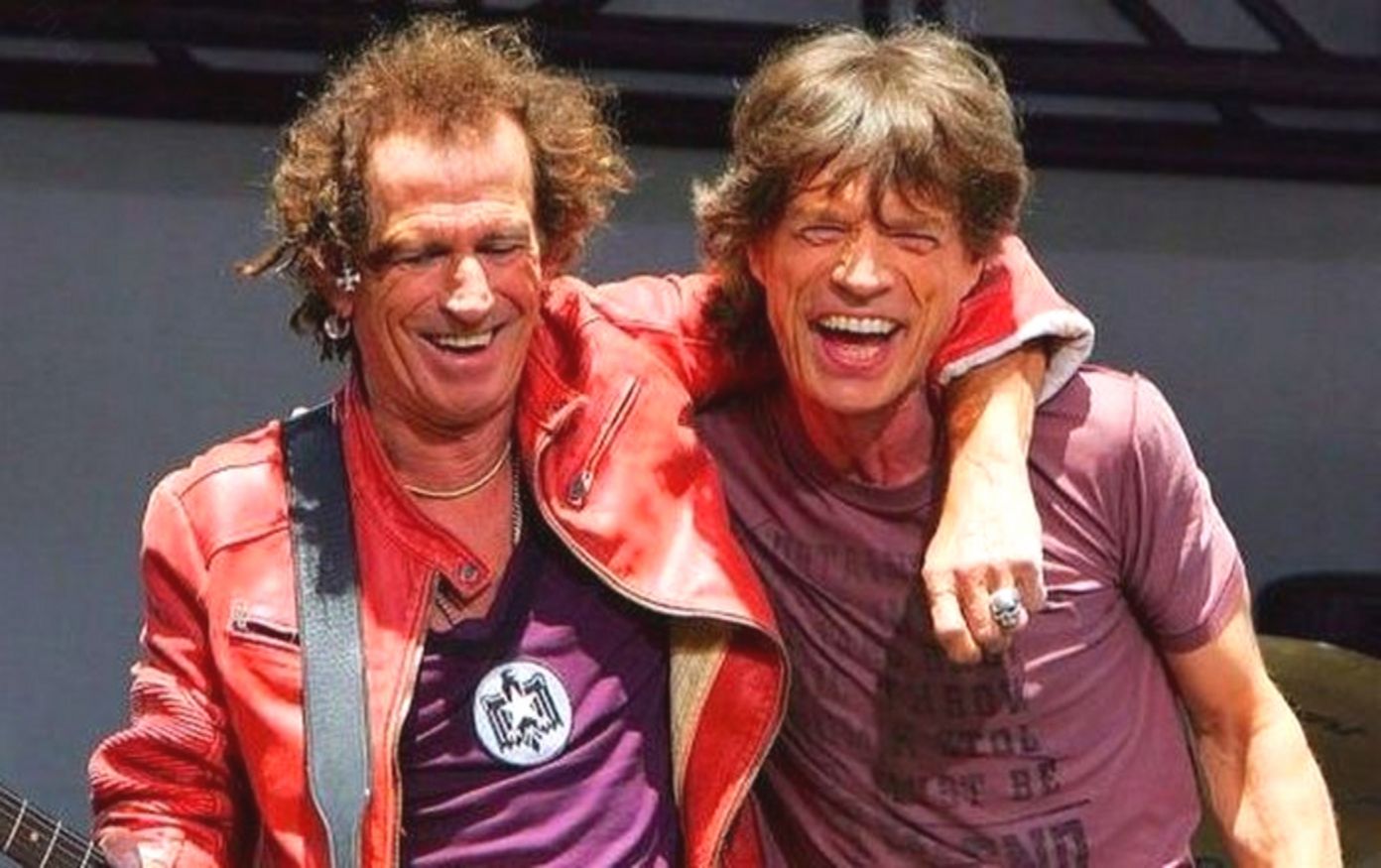
The friendship between guitarist Keith Richards and Rolling Stones vocalist Mick Jagger began in early childhood. They grew up on the same street, were both passionate about music, and their love for the blues led them to come up with the idea of creating a band that would go on to achieve unprecedented worldwide fame and bring their fans such cult hits as Wild Horses and Satisfaction.
But at some point in their lives and joint work, something went wrong, and the friends began to feel a strong dislike for each other.
The beginning of a creative path

They met in the 1940s in the gloomy courtyards of old, grey England, on the outskirts of London, where they spent their early childhood. Mick Jagger and Keith Richards lived on opposite sides of the same street, went to the same school and played simple children’s games in the same courtyards.
At the age of eleven, Keith Richards changed schools because his family moved to the next street, but since their mothers also knew each other and never lost touch, Mick Jagger and Keith Richards met periodically, although they were not yet close friends at that time.
It was a time when they read a lot about cowboys and were into country music. One day in their lives, they had a significant meeting at a train station when Jagger said he had some rhythm and blues records, which were considered very valuable at the time because they were not released in England.
They started visiting each other and listening to these records, and then meeting at other friends’ houses to listen to other records. This led to them becoming closer, collecting records, exchanging records with other music lovers.
Richards played the guitar from the age of five, and Jagger loved to sing, and at some point they combined their interests to become the legendary guitarist and vocalist of one of the most popular bands in the future and confidently enter the history of world rock.
The Creation of the Legendary Group The Rolling Stones

The group was originally formed by Jones Brian, who placed an advert for musicians in a jazz publication. The first to join the group was pianist Ian Stewart, then several more people tried their hand at it, but they did not suit Jones. Finally, Mick Jagger and Keith Richards joined the group, who at the time were also looking for companions willing to play American blues.
After that, bassist Bill Perks, who later changed his last name to Wyman, joined the band. He was older and had never played blues, but he was willing to learn. Bill also had excellent equipment for that time. The last to join the band was drummer Charlie Watts.
Jones was the band’s leader at first, the one who gave the band its name, promoted it, and signed its first contracts. He played several instruments well, was talented, charismatic, intelligent, and able to present himself well, but at the same time he was extremely irresponsible and prone to fraud, which is why The Rolling Stones’ early fame was accompanied by a not very good reputation.
Jones Brian gradually became a liability to the group due to his troublemaking tendencies, drug and alcohol abuse. He eventually squandered his musical talent and left the band he founded a few years later. Three weeks later, Jones mysteriously drowned in his own swimming pool.
After Jones’ departure, Brian’s leadership of the group gradually passed to friends Mick Jagger and Keith Richards. The “Glimmer Twins,” as they were affectionately known for their stellar style, became a force that charmed, captivated, and forced many to reckon with their growing popularity year after year.
Although some of their lyrics were far from perfect, which is why their music was not always accepted by the intelligentsia, they compensated for this with their extreme artistry and mesmerizing dance rhythm. This became the crowning achievement of The Rolling Stones – they could make anyone dance, and when they appeared on stage, they did not have to make much effort to do so.
The Role of Jagger and Richards in the Band’s Popularity

At the time of the band’s creation, Mick Jagger was a student at the London School of Economics. He was a middle-class man, intelligent, charismatic and very ambitious, which helped him later become the band’s leader and sign the most lucrative contracts. His stage moves and rock ‘n’ roll sense made him a crowd favorite.
He was businesslike, thrifty, and quite conservative in many ways. As the band became famous, Jagger became more and more cautious. His conservatism increased over the years, which caused problems in the musicians’ business relationships.
Keith Richards was raised by his mother and sisters and was known for his quiet, but not shy, personality. He considered himself a “cool kid” as a child, who disliked school and had no plans for the future other than playing guitar, which he did constantly both as a teenager and later with the Stones.
Mick Jagger and Keith Richards’ childhood friendship helped them gain control of the group and take The Rolling Stones to great heights. They became the authors of many hits and successfully competed with another legendary British group, The Beatles.
A feud that nearly split the group

The band continued to have good times throughout the rest of the 1970s, their popularity grew, and the friendship between the musicians remained unshakable. But when the MTV era began and the landscape of popular music changed, the band fell on hard times. The friends tried to adapt, but this only put a strain on their relationship.
The Rolling Stones were entering an ageing phase, and Keith Richards believed that some drastic measures had to be taken to renew them, but Mick Jagger’s conservatism was a serious obstacle. They often quarreled, and Richards felt that Jagger was becoming intolerable, and he often expressed his attitude publicly, patronizingly calling his friend “His Majesty.”
By 1980, Richards’s feelings toward Jagger had become so hostile that he finally took his grievances out on songwriting. On Emotional Rescue, Richards sings lead vocals on “All About You,” a song about a man with an inflated ego who wants all the attention for himself. It’s hard not to see some of these lines as aimed at Jagger. On “Had It With You,” Jagger and Richards are no longer shy about throwing backhanded compliments at each other.
Their rift almost destroyed the band at one point, and it seemed that The Rolling Stones would soon cease to exist. But in 1989, they got back together to record a new album, Steel Wheels, and go on tour with it. However, the fragments of their feud remained for a long time.
What secrets about his relationship with Mick Jagger did Keith Richards reveal in his memoirs

The first cracks in the musicians’ relationship appeared in the late 1970s, when Richards, who had previously criticized Brian Jones for his many excesses, himself became addicted to alcohol and drugs, thereby adding to the band’s bad reputation. After his arrest for heroin and a stint in rehab, Jagger was furious about losing control of the group.
Their relationship later became even more strained, to the point that during the recording of the album “Undercover” in 1983, Jagger and Richards could not even be in the same room together.
Chris Kimsey, who co-produced the album, said he had to invite Mick to the studio from noon to 7 p.m., and then Keith from 9 p.m. to 5 a.m. According to Kimsey, they both actively avoided each other, specifically asking when the other would leave the studio.
Keith Richards has never been more open about his friendship with Mick Jagger than in his memoir Life, where he continues to call Jagger his brother. Keith writes that they may not be friends any more – too much has happened to ruin their friendship – but they remain brothers, and that explains a lot about their relationship. “Brothers sometimes quarrel,” he wrote.
Despite the years of hostility, Richards always knew that the best way to communicate with Jagger was not through words, but through music. Speaking about the relationship they built over the years, Richards is open about how music always brought them back together. “You can call it a gentleman’s agreement,” he writes in the book, “but a lot of the barriers go away once we start working.”
What Mick Jagger Said About His Broken Friendship With Keith Richards

After the release of Keith Richards’ memoir, Mick Jagger was hurt by some details about their personal life revealed by his friend. He also didn’t like Keith’s description of him as conservative and cold towards the band’s affairs. “I have many different roles and responsibilities in The Rolling Stones,” he said. “And I have other responsibilities outside the band, so I don’t want to be judged by any one role.”
He said that despite the broken friendship, he also considered Richards his brother, but that the continuation of their relationship was possible only if they met and Keith apologized for some of the unflattering details given in the book. “These things cannot be left unsaid,” Jagger said, “they require clarification.” After that, they met, talked, and Richards actually apologized to Jagger.
The drama has been going on for years and may make for great tabloid headlines, but the real connection between Mick Jagger and Keith Richards is plugging in their guitars and getting lost in the sound they coax out of each other.
Renowned cartoonist Sebastian Kruger, who has been friends with the Rolling Stones for many years and knows them well, says that this connection can never be broken.